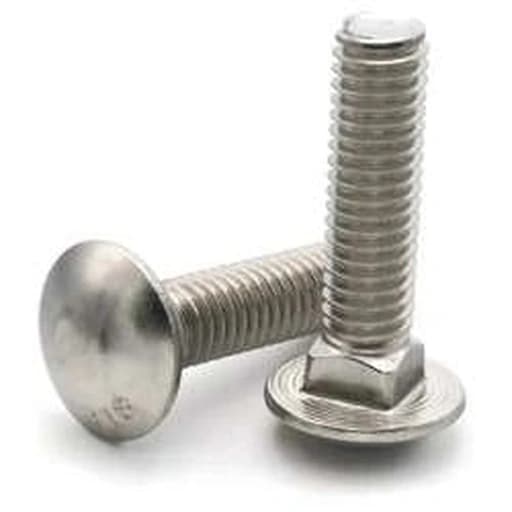
Pick up almost any metric bolt and you'll find a small marking stamped into the head — something like 8.8, 10.9, or 12.9. That's the property class, and it tells you a lot about how the bolt will behave under load before you ever tighten it down. Mixing up grades, or assuming "a bolt is a bolt," is one of the most common and most avoidable mistakes in fastener selection.
What the numbers actually mean
Under ISO 898-1, the property class marking is read as two numbers separated by a dot. The first number, multiplied by 100, gives you the approximate minimum tensile strength in megapascals — so an 8.8 bolt has a tensile strength around 800 MPa, and a 10.9 bolt around 1000 MPa. The second number is the yield-to-tensile ratio expressed as a fraction of ten — the point at which the bolt begins to permanently deform relative to its ultimate breaking strength. Multiply the two together (roughly) and you get the approximate yield strength as a fraction of the tensile figure.
Grade 8.8 — the everyday workhorse
Grade 8.8 is the most widely used structural and general-purpose bolt grade. It offers a good balance of strength, ductility, and cost, which is why you'll find it everywhere from automotive assembly to general steel fabrication and machinery. If a job doesn't call out a specific higher grade, 8.8 is very often the right default.
Grade 10.9 — higher strength, still weldable-adjacent applications
Step up to 10.9 and you get noticeably higher tensile and yield strength, which lets engineers specify a smaller bolt for the same load, or the same size bolt for a higher load. It's common in structural steel connections, heavy machinery, and anywhere the design has been engineered around the higher strength margin. 10.9 bolts are less ductile than 8.8, so they're less forgiving of over-tightening or shock loading beyond their design limits.
Grade 12.9 — the high-strength specialist
12.9 is the highest property class in common industrial use, offering the greatest tensile strength of the three. It's popular in precision machinery, tooling, and high-stress mechanical assemblies. One important caveat: many structural codes explicitly exclude 12.9 (and higher) from structural steel bolted connections, partly because of increased susceptibility to hydrogen embrittlement, especially if the bolt has been electroplated. Always check the governing code or engineering spec before substituting a higher grade than what's called for — higher isn't automatically better.
How to choose
- Start with the design drawing or engineering spec — the grade is usually specified for a reason, not a suggestion.
- Match the grade of nuts and washers to the bolt; a high-grade bolt paired with a low-grade nut can fail at the nut instead.
- Consider the environment — plating and coating choices interact with grade, particularly around embrittlement risk on higher grades.
- Never upgrade a specified grade without checking the code — a stronger bolt is not always a safer bolt in a given connection design.
Sabta Trading stocks 8.8 and 10.9 grade bolts across common sizes and standards, ready to ship from Dubai, with sourcing support for less common grades and specifications on request.